


Mar 2, 2026 12:55:54 PM
Cloud overspend in SMEs is rarely reckless. It is almost always rational. Projects move fast, teams experiment, environments get duplicated "temporarily," and new workloads appear before governance has a chance to catch up. Nobody wakes up intending to waste money in Azure — yet six months later, finance asks why the bill is 28% higher than expected.
The uncomfortable truth is this: cloud cost drift is not primarily a technical problem. It is an operating model problem. And for Swiss SMEs, that distinction matters.
The Myth of "Wasteful IT"
Global data supports what most CIOs already feel. The FinOps Foundation's State of FinOps report consistently shows that organizations struggle less with initial cloud adoption and more with ongoing visibility, allocation, and ownership. Gartner has made the same point repeatedly: cloud financial management is not a tooling gap — it is a governance and accountability issue. The technology works. The model around it often doesn't.
In Swiss SMEs, the pattern tends to be predictable. IT wears too many hats. Finance receives invoices, but not the operational context. Subscriptions multiply without clear owners, and "temporary" workloads quietly become permanent fixtures. This is not mismanagement — it is operational drift.

How Cloud Cost Drift Actually Happens
In Microsoft-heavy SME environments, cost drift usually follows three recognizable mechanisms.
Temporary becomes structural. A development environment is created for a project. A test tenant is spun up for a migration. A backup solution is enabled with premium settings "for now." Nobody formally retires them, and Azure does exactly what it was designed to do: it keeps running. Without an explicit lifecycle review, costs accumulate silently.
Shared responsibility becomes no responsibility. In many SMEs, Azure subscriptions are technically owned by IT, workloads are owned by business units, and budgets are monitored by finance. When ownership is this distributed, accountability diffuses. The FinOps Foundation calls this the "allocation maturity gap" — if you cannot clearly assign cloud spend to a service, team, or outcome, cost optimization becomes political rather than operational. Swiss executives are pragmatic. They don't need perfect attribution. They need clarity, and clarity requires defined ownership.
Governance comes last. Cloud enables speed; governance tends to follow at a distance. Tagging standards get defined after deployment. Budget alerts get created after surprise invoices. Cost reviews happen quarterly, not continuously. Microsoft's own cloud adoption guidance treats cost management as a foundational pillar, not an optimization add-on — yet in SMEs, it is consistently treated as phase two. And phase two rarely arrives.
Why SMEs Struggle More Than Enterprises
Large enterprises build dedicated FinOps teams. SMEs build resilience through people wearing multiple roles, and that difference matters in practice. In a typical Swiss SME, the infrastructure lead is also responsible for security, the security lead is responsible for compliance, and the CIO manages vendor relationships on top of everything else. Cloud governance simply competes with more urgent operational work.
PwC Switzerland reports that 67% of Swiss companies plan to increase cybersecurity investment, yet only a minority feel fully prepared for serious disruption. The same execution gap applies to cloud cost governance — investment intent is strong, but operational discipline lags. Cloud cost drift is rarely about budget size. It is about cadence.
The Smallest Set of Controls That Actually Work
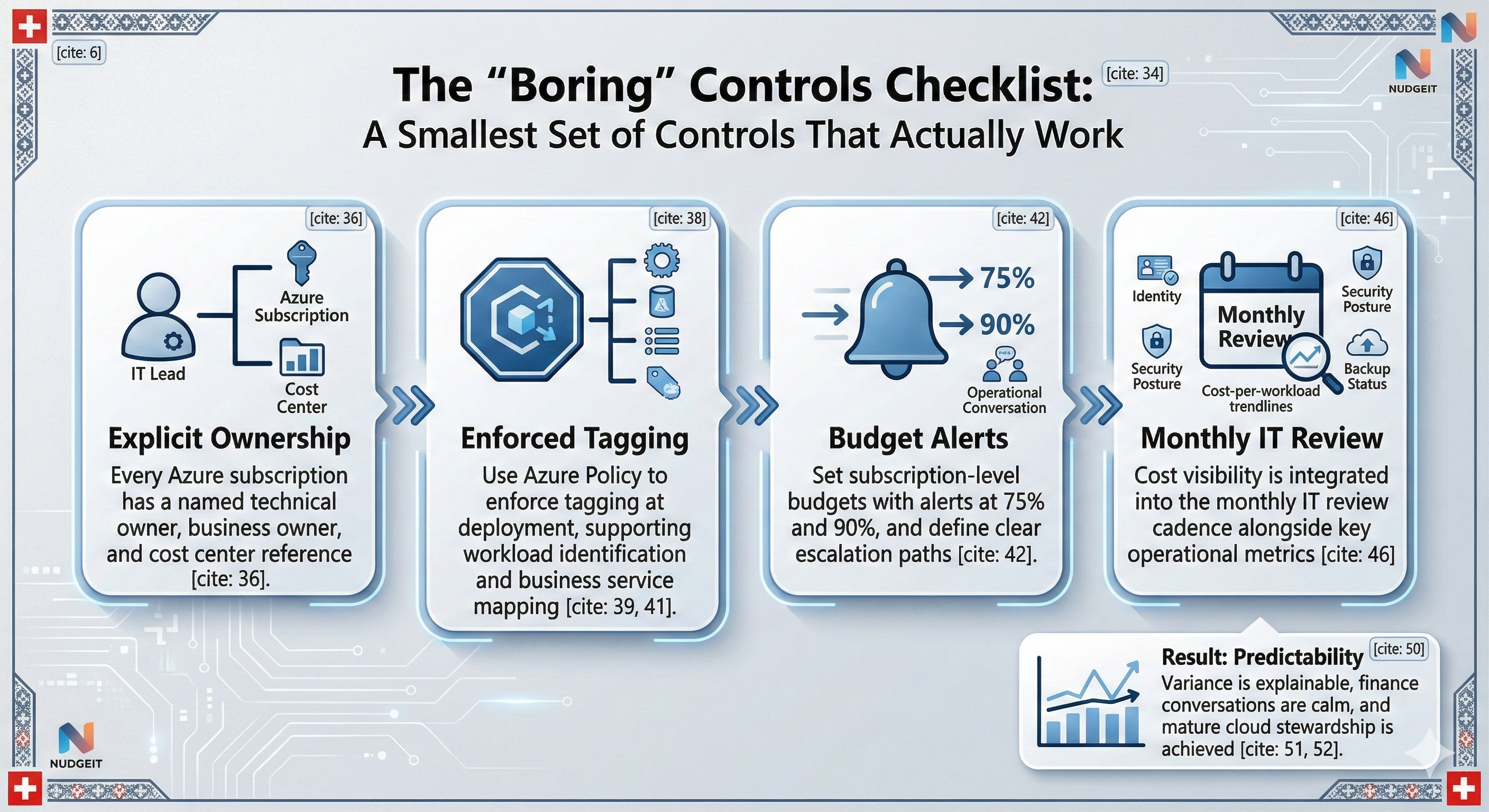
You do not need a FinOps program. You need a few boring controls executed consistently.
- Subscription ownership must be explicit. Every Azure subscription needs a named technical owner, a named business owner, and a cost center reference. If a subscription has no clear owner, it is a liability. Ownership doesn't eliminate cost — it eliminates ambiguity.
- Tagging that isn't just aspirational. Most SMEs define tagging standards; few actually enforce them. Tags need to support workload identification, environment classification (prod, test, dev), and business service mapping. If your tagging can't support a cost conversation with finance in ten minutes, it's decorative. Azure Policy can enforce tagging at deployment — use it, quietly.
- Budgets as conversation starters, not control mechanisms. Set subscription-level budgets with alerts at 75% and 90%, and define clear escalation paths. When alerts trigger, the conversation should be operational — "What changed? Is this expected? Is this temporary?" — not accusatory. Swiss organizations respond well to structured review, not blame.
- Cost visibility for IT, not just finance theatre. Cloud cost dashboards often exist for executive reporting but are rarely used for engineering decision-making. Azure Cost Management should sit inside the monthly IT review cadence, alongside identity metrics, security posture, and backup status. Cost governance belongs inside IT operations — not outside it.
What Success Actually Looks Like
The goal is not the lowest possible bill. It is predictability. When monthly variance is explainable, finance conversations are calm, new workloads are evaluated with cost awareness, and "temporary" environments have expiry dates — that is maturity. The goal, simply, is fewer surprises.
A 60-Day Stabilization Approach for Swiss SMEs
If your Azure bill feels unpredictable, the path forward is straightforward.
In the first two weeks, focus on visibility: inventory your subscriptions, assign owners, review your top ten cost drivers, and identify unattached resources like orphaned disks, IPs, and snapshots. Over weeks two to four, build structure by enforcing tagging via policy, implementing budget alerts, and defining lifecycle rules for dev and test environments. From week four through eight, establish cadence — a monthly 45-minute cloud review, a cost-per-workload trendline, and a regular pass over idle or underutilized resources.
No new tooling required. Just discipline.
NUDGEIT's Point of View
Cloud cost control is not about squeezing vendors. It is about operational clarity. In Microsoft-centric SME environments, most cost drift traces back to undefined ownership, a lack of review cadence, and governance introduced too late in the process.
You don't need enterprise FinOps. You need structured accountability and consistent review. Swiss CIOs value predictability — and cloud governance, done properly, delivers exactly that: calm conversations with finance, fewer surprise invoices, and an IT function that feels intentional rather than reactive.
Submit a comment